
.webp)
Property managers constantly balance maintenance quality with operating costs. When sidewalks become stained, dumpster areas collect grease, or building entrances lose their clean appearance, one question often comes up: should your maintenance team handle pressure washing, or should you hire a professional company?
Comparing the in house vs professional commercial pressure washing cost requires looking beyond the initial invoice.
An in-house crew may appear cheaper because employees are already on payroll. However, equipment, labor hours, training, cleaning chemicals, maintenance, setup time, safety procedures, and employee availability all contribute to the real cost.
Professional service has a direct price, but it can also reduce the amount of time property staff spend managing specialized exterior cleaning.
For property managers in Fort Worth, Burleson, and nearby communities, understanding the complete cost picture can make it easier to choose the right approach for each property.
The lowest visible cost is not always the lowest total cost.
Here is a practical comparison.
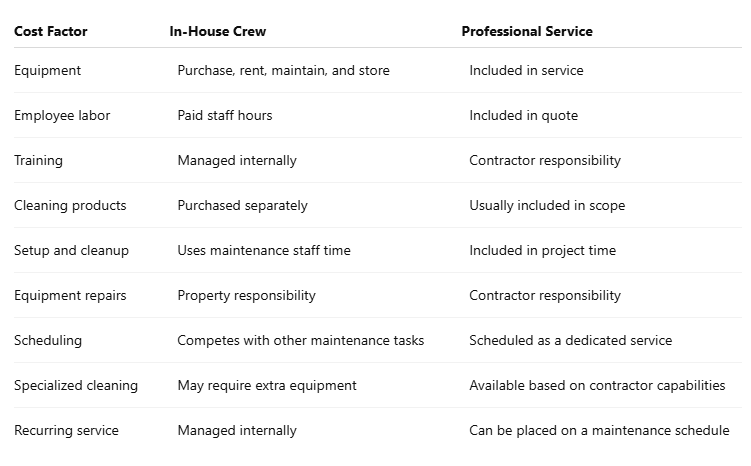
The right option depends on how often cleaning is needed, how large the property is, and what type of buildup must be removed.
Property managers sometimes calculate in-house cleaning using only an employee's hourly wage.
That leaves several expenses out of the equation.
Commercial cleaning requires more than a small consumer pressure washer if the property includes large sidewalks, dumpster pads, loading zones, or extensive concrete.
Potential equipment expenses include:
Equipment also needs storage, maintenance, and occasional repairs.
If a machine fails during a scheduled cleaning day, employees may lose productive time while the equipment is repaired or replaced.
Professional contractors typically bring equipment specifically intended for exterior cleaning work, which shifts those ownership and maintenance responsibilities away from the property manager.
Labor is often the largest hidden expense in an in-house cleaning program.
Suppose a maintenance employee spends several hours pressure washing sidewalks. Those hours are no longer available for tenant requests, repairs, inspections, landscaping coordination, preventative maintenance, or other property responsibilities.
Ask what your maintenance team could be doing instead.
For example, using an employee for six hours of pressure washing may seem inexpensive until an urgent maintenance request, unit turnover task, plumbing issue, or building repair is delayed.
This is especially relevant for managers overseeing multiple properties with limited maintenance staffing.
Professional commercial pressure washing services can allow an internal team to remain focused on the work they are already responsible for managing.
Outsourcing is not automatically necessary for every cleaning task.
In-house work can make sense when the job is small, simple, and infrequent.
A small patch of dirty concrete outside a maintenance room is different from cleaning several thousand square feet of commercial walkways.
The scope should guide the decision.
Professional service becomes more attractive as the job becomes larger, dirtier, more frequent, or more complicated.
Exterior cleaning for property managers can involve many different areas, including:
A professional cleaning company can plan the process around the surface and contamination rather than using the same method everywhere.
A lightly dirty sidewalk may only need straightforward cleaning.
A dumpster enclosure containing grease, food residue, odors, and organic buildup may require pretreatment, degreasing, specialized equipment, and a more detailed cleaning process.
Total Wash and Stripe offers dedicated dumpster pad cleaning and sanitation for commercial properties dealing with these conditions.
Return on investment does not always mean generating direct revenue from pressure washing.
For property managers, ROI can come from saving internal labor, reducing management time, creating more consistent exterior maintenance, and helping properties maintain a professional appearance.
Every maintenance department has limited hours available.
Outsourcing exterior cleaning allows those hours to remain available for tasks that may require direct knowledge of the property.
This can be particularly valuable for managers responsible for several locations.
In-house pressure washing is often postponed when higher-priority maintenance problems arise.
A scheduled contractor visit creates a defined cleaning cycle.
That can help prevent sidewalks, entrances, dumpster areas, and other exterior surfaces from being cleaned only after they become noticeably dirty.
Customers and tenants often see sidewalks, entrances, storefronts, and parking areas before they see anything inside the building.
Regular exterior cleaning can support the overall presentation of a commercial property.
Property managers can review examples of completed exterior work in the Total Wash and Stripe project gallery.
One-time pressure washing is useful when a property already needs significant cleaning.
Recurring commercial cleaning services take a more preventative approach.
Instead of waiting for grime to become severe, cleaning is scheduled at planned intervals.
The ideal schedule depends on traffic, surface type, surrounding vegetation, grease exposure, tenant activity, and the standards set for the property.
A restaurant dumpster pad may need attention more often than a rear building wall.
A high-traffic entrance may become dirty faster than an isolated sidewalk.
Property managers can reduce unnecessary spending by identifying high-priority zones and creating different cleaning frequencies for each.
Managing several vendors can create additional administrative work.
When appropriate, property managers may benefit from coordinating related exterior maintenance.
For example, a property that needs pressure washing may also have storefront glass that requires regular attention.
Total Wash and Stripe provides commercial window cleaning, allowing businesses to discuss multiple exterior maintenance needs through the same company.
Bundling does not automatically mean every service should happen at the same frequency. The goal is to create a maintenance plan that matches how the property is actually used.
To make a fair comparison, calculate the full internal cost first.
Add together:
Then compare that figure with the professional quote and scope.
A low price means little if the scope is different.
Ask whether the quote includes:
A detailed comparison helps property managers make a decision based on value rather than the headline number alone.
Commercial properties in Fort Worth and Burleson experience different cleaning demands based on traffic, tenants, food-service activity, building design, and surrounding conditions.
Some properties only require periodic cleaning. Others benefit from a structured maintenance schedule.
Total Wash and Stripe works with commercial properties that need exterior cleaning solutions tailored to the actual property rather than a one-size-fits-all plan.
Property managers researching a service provider can also read Total Wash and Stripe customer reviews on Google and evaluate previous customer experiences.
The in house vs professional commercial pressure washing cost comparison is ultimately about more than deciding who can operate a pressure washer for the lowest hourly expense.
For occasional light cleaning, an available maintenance employee may be a practical solution.
For large properties, recurring cleaning, grease removal, high-traffic areas, or multi-site portfolios, outsourcing can reduce the amount of equipment, employee time, and management effort required internally.
Property managers should evaluate the total cost of completing the work, not simply compare an employee's wage with a contractor's invoice.
If your commercial property needs a one-time cleaning or a recurring exterior maintenance plan, request a commercial cleaning quote from Total Wash and Stripe to compare professional service with your current in-house approach.
No. It may appear cheaper if you only consider employee wages. The full cost can also include equipment, maintenance, chemicals, PPE, training, setup time, supervision, and employee hours taken away from other maintenance duties.
Compare labor, equipment ownership, maintenance, chemicals, training, scheduling, cleanup, management time, and the scope of work. This creates a more accurate comparison between internal cleaning and a professional contractor.
It depends on the size and complexity of the cleaning. Small areas with light dirt may be manageable internally, while grease, extensive concrete, recurring cleaning, or specialized surfaces may make professional service more practical.
Recurring service creates a planned maintenance schedule, helps control buildup, reduces the need to repeatedly arrange one-time cleanings, and can make exterior cleaning expenses easier to anticipate.
There is no universal schedule. High-traffic entrances, restaurant service areas, and dumpster pads may need more frequent cleaning than low-traffic surfaces. The best schedule should be based on the property's use and how quickly buildup returns.
Yes. Total Wash and Stripe offers multiple commercial and exterior cleaning services, allowing property managers to discuss sidewalks, building exteriors, dumpster pads, windows, and other property needs.
Provide information about the property, the surfaces that need cleaning, problem areas, approximate size, and whether you are interested in recurring service. You can contact Total Wash and Stripe to request a customized estimate.


