

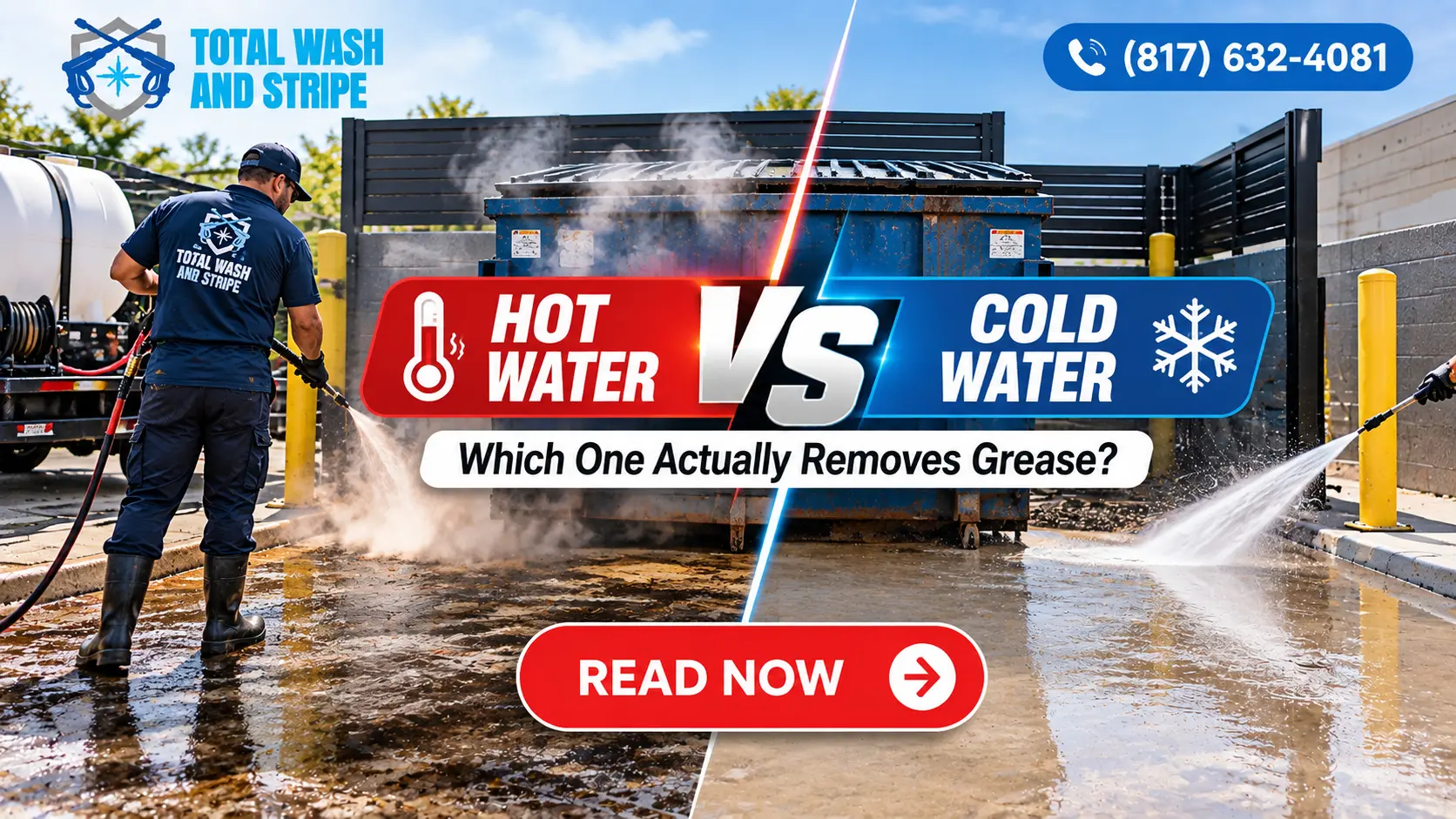
A restaurant dumpster area can look completely different from ordinary dirty concrete. Instead of dust and surface dirt, dumpster pads often collect cooking grease, food residue, leaking liquids, sticky organic buildup, and stains that have been sitting on porous concrete for weeks.
That raises an important question for restaurant owners and property managers: which method actually works better for grease?
When comparing hot water vs cold water dumpster pad cleaning, hot water generally has an advantage on oily and greasy contamination because heat helps loosen fats and oils from the surface. Cold water can still be useful for loose debris, dirt, and lighter buildup, but stubborn restaurant grease often requires more than pressure alone.
Total Wash and Stripe provides professional dumpster pad cleaning and sanitation for commercial properties in Fort Worth and surrounding communities.
Here is what businesses should know before choosing a cleaning method.
Both systems use pressurized water to remove contamination from a surface. The main difference is the temperature of the water and how that temperature affects different types of buildup.
Cold water relies more heavily on water pressure, cleaning products, agitation, and repeated passes.
Hot water adds heat to the cleaning process, which can make greasy and oily contamination easier to break apart.
Cold water pressure washing can be effective for:
For an area that receives little food or grease contamination, cold water may be enough to improve the appearance of the concrete.
Restaurant dumpster pads present a different challenge.
Cooking oils, fats, sauces, food residue, and leaking garbage can create a greasy film that bonds to concrete. Once that material cools and settles into the surface, pressure alone may struggle to lift it efficiently.
Heat helps soften and loosen oily buildup so it can be removed more effectively during the cleaning process.
Think about washing a greasy pan in a kitchen.
Cold water may move loose food particles, but warm or hot water generally makes greasy residue easier to break down. A similar principle applies when cleaning heavily contaminated commercial concrete.
Grease changes consistency as its temperature changes.
When fats cool, they can thicken and cling strongly to a surface. Heat can soften that material, making it easier for cleaning solutions and pressurized water to separate it from the concrete.
This can be especially useful around:
More pressure does not automatically mean better grease removal.
Using excessive pressure without the right cleaning process can waste time and may be unnecessarily aggressive on the surface.
Effective grease removal often involves several steps, including pretreatment, appropriate degreasing products, adequate dwell time, hot water when appropriate, controlled pressure, rinsing, and proper handling of dirty wash water.
That complete process is one reason businesses often hire a professional instead of trying to solve severe grease buildup with a basic pressure washer.
Yes, cold water can remove some grease, especially when contamination is fresh or relatively light.
However, it may require more chemical assistance, repeated cleaning, agitation, or additional time compared with a properly equipped hot-water system.
Cold water can make sense when:
The key is matching the cleaning method to the actual condition of the property.
A lightly used commercial dumpster area does not necessarily need the same process as a busy restaurant waste enclosure that receives food waste every day.
A common mistake is pointing a pressure washer at dark grease stains immediately and expecting water pressure to do all the work.
For difficult grease removal, dumpster pad cleaning usually benefits from preparation.
An appropriate commercial degreaser can help loosen the bond between grease and concrete before pressure washing begins.
The product needs enough contact time to work. Immediately spraying it away may reduce its effectiveness.
Allowing a cleaning solution to remain on the surface for the appropriate amount of time gives it an opportunity to penetrate oily buildup.
The specific product, surface condition, weather, and contamination level all affect how the cleaning process should be handled.
This is why professional cleaning is more than simply using a powerful machine.
Businesses looking for commercial degreasing pressure washing in Fort Worth often include restaurants, shopping centers, grocery stores, apartment communities, convenience stores, and property management companies.
These properties can develop grease and organic buildup in several areas, including dumpster pads, sidewalks, loading areas, back entrances, drive-through lanes, and service corridors.
Total Wash and Stripe provides commercial pressure washing services that can address multiple exterior areas during a scheduled service visit.
Removing grease from concrete creates contaminated wash water.
That water may contain:
It should not simply be pushed toward a storm drain because the visible stain has disappeared.
Fort Worth regulates commercial pressure-washing activities and pollutant discharges into the storm-drain system. For commercial customers, this makes wash-water management an important part of selecting a cleaning provider.
A quality cleaning job should consider both what comes off the concrete and where that material goes afterward.
Hot water is useful, but it is not a magic solution.
A neglected dumpster pad may still require multiple cleaning steps.
Results can be influenced by:
Some older stains may also leave discoloration even after oily contamination has been substantially removed.
Setting realistic expectations matters, especially when a dumpster pad has gone without professional cleaning for a long period.
You can view examples of exterior cleaning projects in the Total Wash and Stripe work gallery.
Restaurants should not wait for a thick black layer of grease before scheduling service.
Frequent maintenance can prevent the buildup from becoming increasingly difficult to remove.
Consider scheduling service if you notice:
Properties with high food volume may benefit from recurring maintenance rather than occasional emergency cleaning.
A recurring schedule can also make each visit more manageable because grease has less time to harden and accumulate.
Not necessarily.
Professional cleaning should match the equipment and process to the contamination being removed.
Cold water may be perfectly suitable for dirt, loose grime, and routine rinsing. Hot water becomes especially valuable when fats, oils, and stubborn greasy residue are the main problem.
The goal is not to use the hottest water or highest pressure possible. The goal is to use the right combination of heat, cleaning products, water flow, pressure, and technique for the surface.
That approach can produce better results while avoiding unnecessary cleaning steps.
When comparing contractors, ask more than whether they own a pressure washer.
For restaurant and commercial work, ask:
Total Wash and Stripe works with commercial properties that need ongoing exterior maintenance as well as one-time cleaning.
Business owners can also read customer feedback for Total Wash and Stripe on Google when evaluating a local pressure washing provider.
For heavy restaurant grease, hot water often provides a practical advantage over cold water because it helps loosen oils and fats that have bonded to concrete.
But the best results come from more than temperature alone.
Proper pretreatment, degreasing, dwell time, pressure, rinsing, and wastewater management all contribute to a more thorough cleaning process.
If your restaurant, retail property, apartment community, or commercial facility has a greasy waste area, Total Wash and Stripe can evaluate the condition of the pad and recommend an appropriate cleaning approach.
Contact Total Wash and Stripe for a commercial cleaning estimate to discuss one-time or recurring dumpster pad service in Fort Worth and surrounding service areas.
Hot water is generally more effective when a dumpster pad contains significant grease, fats, oils, or food residue. Cold water can work well for loose dirt, debris, and lighter contamination. The right option depends on the condition of the surface.
Hot water can help loosen oily buildup, but older stains may require pretreatment, degreasing products, dwell time, and multiple cleaning steps. Some deeply absorbed discoloration may remain even after surface grease has been removed.
It depends on the amount and type of contamination. Heat can make grease easier to remove, but heavily soiled restaurant pads may still benefit from an appropriate commercial degreaser and proper dwell time.
Yes. Cold water can remove loose dirt and lighter buildup and may handle some grease when paired with the right cleaner. For heavy or hardened restaurant grease, hot-water cleaning is often more efficient.
The service can vary depending on the property. A professional process may include inspection, debris removal, pretreatment, degreasing, pressure washing, rinsing, and appropriate management of dirty wash water. Visit the Total Wash and Stripe FAQ for additional service information.
There is no single schedule for every restaurant. Waste volume, grease accumulation, odors, traffic, weather, and the condition of the pad all matter. High-volume restaurants may benefit from recurring service so buildup is addressed before it becomes severe.
Yes. Depending on the property and requested scope, businesses can discuss dumpster pads along with sidewalks, concrete areas, storefront surfaces, and other exterior cleaning needs. Explore the company's commercial and exterior cleaning services or request a customized estimate.


